How I Wrote 9 Novels in 6 Years While Running 2 Businesses — My Writing System
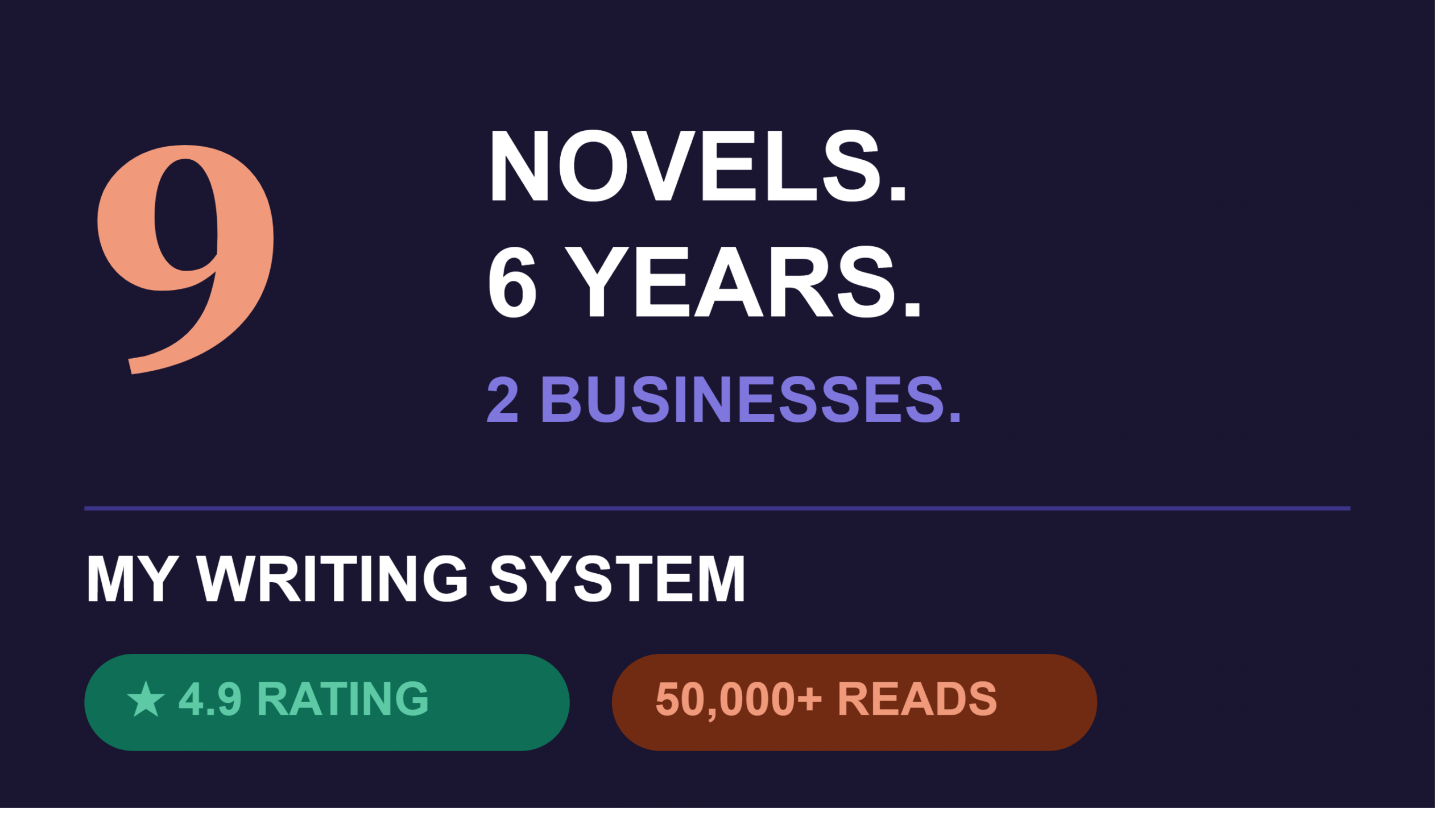
Nine novels. Six years. While I was working full-time and running two businesses.
People hear that and assume I quit my job, or I've got no kids, or I'm some kind of writing savant. None of that's true. What I had — what I built — was a system. And today I'm going to give you a piece of it for free."
Real quick, so you know I'm not just talking — these books hit 4.86 to 4.93 star ratings, and over 50,000 reads, on top of a full-time career and running two businesses.
That novella got 54,000 reads and a score of 4.67 out of 5 stars! One of those chapters scored 4.93 stars! Another short story got 2300 reads and a score of 4.86.

I'm not telling you that to brag. I'm telling you because I looked for a course like this when I started in 2019, and I couldn't find one. Everything out there was punctuation drills and grammar rules — nothing about the system that actually gets a book started, finished, and read.
So I built my own. This video is about the very first piece of it: how I actually start a story."
Here's the problem most new writers run into: they either wait around for 'inspiration' to strike, or they sit down with a blank page and just start typing and hope it holds together.
Both of those are slow, and both of those quit on you halfway through a manuscript.
Instead, I use a four-step method to go from a spark of an idea to a story that actually holds up. I call it: Facts → Presumptions → Questions → Premise."
Step 1 — Facts
"Start with facts. Not facts about the world — facts about this story. Who is this person? Where are they? What's true about their situation right now, before anything happens?
This isn't creative yet. It's just laying bricks. A list. 'She's 34. She just left her job. She hasn't spoken to her sister in three years.' That's it — plain, grounded facts."
Step 2 — Presumptions
"Once you've got facts, you build presumptions on top of them. This is where you ask: given these facts, what would reasonably follow? What does the reader assume is going on?
If she just left her job and hasn't spoken to her sister in three years, a reader might presume there's tension, maybe regret, maybe she's about to reach out. You're not deciding the story yet — you're mapping what a reader's brain naturally fills in."
Step 3 — Questions
"Now — and this is the part most people skip — you turn those presumptions into questions. Real questions a reader would actually ask.
'Why did she leave her job?' 'What happened with her sister?' 'Is she going to reach out, or run further away?'
These questions are gold. They're literally your plot's job security. Every scene you write from here on is either asking a new question or answering an old one."
Step 4 — Premise
"Last step: you turn all of that into a premise. One or two sentences that define what the story actually is. Not the plot, not the ending — just the core tension the whole book is going to live inside.
Something like: 'A woman who walked away from everything has to decide whether going back means healing — or losing herself all over again.'
That's your compass. Every chapter, every scene, gets tested against that premise. Does it serve it? Keep it. Doesn't? Cut it.
WHY THIS WORKS
Here's why this matters more than talent: this method takes the terrifying part — 'what do I even write?' — and turns it into a checklist. Facts. Presumptions. Questions. Premise.
Other Articles
-
Who Killed Charlie Kirk?
I want to start this by saying that I don’t know who killed Charlie Kirk. I’ve said that before. What I want to share here is why so many people doubt the official narrative and where it goes from here. …
-
The Harmful Messages Society Sends to Young Women
I often ask my readers to consider the many problems we face in Western Civilization and to answer the question: Are we thinking about the harmful messages society sends to young women? Are those messages and what we’re telling them …
The Harmful Messages Society Sends to Young Women Read More »
-
Should You Use A Human Actor or AI Text-to-Speech in Creating Your Audiobooks?
Human Actor or AI Text-to-Speech? The replacement of human narrators with AI-generated voices in audiobook production is a highly controversial topic in today’s authoring world. (This article is part of my Udemy Course, Becoming an Author: The Master Class Series. …
Should You Use A Human Actor or AI Text-to-Speech in Creating Your Audiobooks? Read More »